Latest from PhoneArena

YouTube Mobile Site Trumps Dedicated App

YouTube Mobile Site Trumps Dedicated iPhone App
Goodbye YouTube software app, hello YouTube Web app. Google aims to kill off the YouTube mobile software app with a better mobile Web version compatible with iPhone and Android phones. The new YouTube mobile Web site was introduced Wednesday for smartphones and uses higher-quality HMTL5 video, a more polished user interface, and features video search suggestions.

Key Differences With Web App
Since Google doesn't control the native YouTube app on the iPhone -- Apple does -- there are features you won't find in the Web version of YouTube. For example, the native iPhone YouTube app features the 5-star rating system, which the site abandoned in January in favor of thumbs up/down ratings.

Another problem with the native iPhone app is that it uses video streams meant for EDGE (2.5G) connection speeds, which are usually quite blurry -- especially on the iPhone 4's high-res Retina Display. Given the competition between Apple and Google in the smartphone area, perhaps YouTube decided to up the ante with an improved mobile site.

The new YouTube mobile site leverages higher-quality HTML5 videos, which won't open in your dedicated YouTube app anymore. So instead of using the app, Google wants you to use the mobile site (it even allows you to bookmark the page on your home screen by tapping the plus sign at the bottom in Safari and tap "Add to Home Screen").


YouTube Web App Advantages
There are several key advantages of the new YouTube mobile site over the dedicated app. First off, you get higher quality video. I pitted an iPhone (dedicated app) alongside an iPod touch (Web app) and the video quality on the iPod touch was noticeably better.

The YouTube Web app also features search suggestions as you type in the search box, something that is missing from the native app. The Web app makes it easier to comment and rate videos as well, and clips will play within the browser, and fill the screen when the phone is oriented horizontally.

Additionally, any new features YouTube rolls out for its site will be integrated faster in the Web app, rather than waiting for an OS update for your phone to integrate them.

The one hurdle YouTube's mobile site will have to jump is getting iPhone users to add the Web app to their home screen, so that it is easier to access. As seen on TechCrunch, Google has that ground covered -- when you visit the site from your iPhone a pop-up will prompt you to bookmark the site.

In recent weeks Google has also made several updates to the interface for the mobile Gmail Web app that runs on Apple mobile devices, giving users a more solid alternative to the built-in Mail app on iPhones and iPads. This follows the tensions between Apple and Google with the rejected Google Voice app, which took the form of a Web app as well, signalling that the search giant is still trying to reach the huge iOS user base.

If you haven't tried the new YouTube mobile yet, the company made a brief promotional video demonstrating the new features (embedded below).


SOURCE:pcworld
Read More!

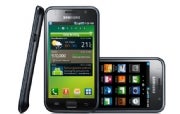
Samsung Galaxy S: How Does It Measure Up to the Competition?

This spring, Samsung introduced the Samsung Galaxy S, a super Android smartphone to rival the HTC EVO 4G, the various Droids (both Motorola's and HTC's) and of course, the iPhone 4. Versions of the Galaxy S will be making its way to U.S. shores this summer in four different form factors to all four major U.S. carriers. I was lucky enough to get my hands on the original European Galaxy S and did some quick side-by-side comparisons with the other hot phones of the summer.

Design and Display
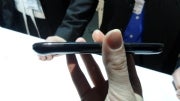
When I first picked up the Galaxy S, I was amazed with how thin and lightweight it was. I was also surprised by how familiar it looked. The design is actually very iPhone 3GS-like with an all black, shiny plastic body and minimal buttons on the phone's face. It is thinner than both the EVO 4G and the Droid X measuring 0.39-inches thick, but slightly beefier than the ultra-slim 0.37-inch iPhone 4. It is the lightest of the bunch, weighing a scant 4.2 ounces.

The Galaxy S's feather-light weight is due in part to the Super AMOLED technology, which the Samsung first introduced at Mobile World Congress on the Samsung Wave. Super AMOLED technology has touch sensors on the display itself as opposed to creating a separate layer (Samsung's old AMOLED displays had this extra layer) making it the thinnest display technology on the market. Super AMOLED is fantastic; you really have to see it in real life to experience it. Colors burst out of the display and animations appeared lively and smooth.

The Galaxy S' 4-inch display is larger than the iPhone's (3.5-inches), but smaller than the HTC EVO 4G and Motorola Droid X's displays (4.3-inches). Despite its smaller size, the Galaxy S outshined both the Droid X and the EVO 4G in my casual side-by-side comparisons. The side-by-side with the iPhone 4 was a closer call. The iPhone 4's display appeared slightly sharper, but I thought the Galaxy S's colors looked more natural. It is really hard to declare a winner--both displays are stunning.

Samsung TouchWiz 3.0 with Android 2.1
The Samsung Galaxy S runs Android 2.1 (Eclair) with Samsung's own TouchWiz 3.0 user interface. Overall, this version of TouchWiz is a lot better than the version on the Samsung Behold II for T-Mobile, which was slow and difficult to navigate. But while this version is an improvement, I encountered some familiar issues with TouchWiz 3.0. Despite the 1GHz Hummingbird processor, the phone lags when launching apps, flipping through menus and scrolling down contact lists or Web pages. This could be due to the fact that this is a pre-production unit, however, and not everything is in perfect working order.

Like HTC Sense, Samsung has its own social media aggregator. Social Hub combines streams from your Facebook, MySpace and Twitter accounts into a single view. It is a useful feature if you need a simple way to keep track of your networks. One odd feature is Mini Diary, which lets you create blog entries with photos, weather info, texts and more. This would be a great feature if you could actually sync this information to your blog or Facebook profile--but weirdly, you can't.

Camera
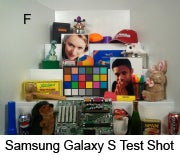
We put the Galaxy S's 5-megapixel camera through a modified version of our PCWorld Lab Test for point-and-shoot digital cameras along with the iPhone 4, the Motorola Droid X and the HTC EVO 4G. Unfortunately our test panel was not very impressed with the Galaxy's photo quality. The Galaxy S phone earned the lowest score out of the four and an overall word score of "Fair." It finished ahead of the Evo 4G in terms of exposure quality, but finished in last place in our color accuracy, sharpness, and distortion tests.

On the other hand, it took second place in overall video quality. Its performance was skewed heavily toward good performance in bright light. According to our panel, bright-light footage looked a bit underexposed and slightly grainy in a full-screen view, but great at smaller sizes. The Galaxy S's auto-focus searches a bit before locking onto a crisp image. Its microphone actually picks up audio a bit too well: our audio clip sounded far too loud and blown-out, while it was barely picked up at all by some of the other smartphones in this comparison. In low light, the footage was a bit too murky and undefined to earn a better rating.


SOURCE:PCWORLD.COM
Read More!

Droid X vs. iPhone 4: Spec Smackdown

On Wednesday, Motorola introduced the Droid X -- the company's response to the Apple iPhone 4. On Thursday, the iPhone 4 goes on sale. As a result, the digital world has a smartphone smackdown rivaling a wrestling match promoter Vince McMahon might emcee. What follows is a specification comparison between the hardware and software of the Droid X and the iPhone 4. Stay tuned for hands-on testing comparing the two models.

Like the iPhone 4, the Droid X is not a big surprise, as "leaked" images and specifications of the device surfaced on the Web weeks ago.

Image courtesy of WWEBut it's official now: Verizon, Motorola, and Google have launched their latest competitor to the iPhone 4, which created mayhem at pre-ordering stage, with over 600,000 advance sales recorded.

So how does the Motorola Droid X stack up against the Apple iPhone? Ultimately, this is a battle royale between two very different platforms: the iOS from Apple, a walled garden that sees no stopping in growth, and the Android platform, which is quickly catching up by adding powerful devices and galloping software updates.

We will look at some of the key software and hardware features of the iPhone 4 and Droid X, comparing and discussing. Note that, until the Droid X arrives on July 15 (with a price of $199 after a $100 rebate with a two-year contract), we won't be able to do a hands-on comparison, so this a comparison based on listed specifications.

Before we start, you can also have a look at our comparison chart.


Processing Power

Tie

Like most modern smartphones, the Droid X runs on a 1GHz processor. The iPhone 4 runs on the same A4 chip you'll find in the iPad, though the clock speed has not been disclosed. (In the iPad, it's 1GHz.) Both Motorola and Apple have not specified the amount of RAM memory in their devices, but we know so far from a recent teardown of the iPhone 4 that the device features 512MB of RAM, a figure that you can expect from the Droid X as well.

When both phones become available, a proper speed comparison will be in order.
 

Display & Resolution

Winner: iPhone 4

The Motorola Droid X features a 4.3-inch screen, a whole 1.2 inches larger than the iPhone 4's 3.5-inch display. Both devices' displays are multitouch. But the winner in this category has to be the iPhone 4 because it packs more pixels per inch in its 'Retina display' than the Droid X.

The screen on the Droid X might be better for watching videos due to its larger size, but in terms of picture quality, the iPhone 4's higher resolution and IPS screen technology packs the final punch.

Screen size, of course, can be a matter of preference, but most consumers probably won't need the extra screen space on the Droid X, especially when it's at the detriment of image quality. Also, the extra screen estate on the Droid X makes the phone wider, taller, and heavier than the iPhone 4.
 

Storage

Winner: Droid X

The iPhone 4 does not come in a 64GB version, like the iPod touch, but only in 16GB and 32GB models like the previous 3GS generation. The Droid X however, comes with 8GB of storage built-in, as well as with a 16GB microSD card included.

Because the Droid X supports microSD cards up to 32GB, you can extend its storage up to 40GB. The iPhone 4 does not have extendable storage.

Overall, for the $199 base model price, the Droid X comes with 8GB more storage than the iPhone 4 carrying

the same price (the 16GB model).
 

Camera & Multimedia

Draw

We have already seen photo samples taken with the iPhone 4's 5MP camera, and they look great. It has an LED flash for taking pictures in low-light conditions, and it can record 720p HD video. But the Droid X comes with an 8MP camera and a dual LED flash, and it can also record 720p video.

Add to that the HDMI-out port on the Droid X, and Motorola's device wins hands down. The iPhone 4 however, has a couple more tricks up its sleeve here. Apple's device has a front-facing video camera for video calls (a feature missing on the Droid X), and you can purchase, for $4.99, iMovie for iPhone, simply the best mobile video editor seen so far (and exclusive to the iPhone 4).

We'll conduct side-by-side tests of the cameras on these phones in the near future. Until that time, based on the specs alone, we'll call it a draw.
 

Connectivity

Winner: Droid X

In the connectivity department, the Droid X and the iPhone 4 reach a draw -- to a point. Both phones come with Wi-Fi, GPS, and Bluetooth, and both devices can be used as a modem (tethering) for $20 extra per month. What the Droid X can do and the iPhone 4 can't is to act like a mobile hotspot. For those extra $20 per month, the Droid X allows you to connect up to five compatible Wi-Fi devices to Verizon's network, such as your laptop, your iPad, or other gadgets.
 

iOS vs. Android

Draw (So Far)

The Droid X might have the edge over the iPhone 4 in terms of hardware overall, but lately consumers are focused on how easy and rich the OS on a smartphone is. In this department, Android is making huge leaps lately, but still has some catching up to do.

Usability aside, the problem with the Droid X is that it won't ship with the latest version of Android (2.2) on July 15, but only with the current Android 2.1. This means that only in sometime "late summer," when the Droid X goes Android 2.2, will the phone have full Adobe Flash support (something you won't find on an iPhone any time soon).

Multitasking arrived in iOS 4 as well, so Android doesn't have that advantage over the iPhone anymore, either. Same goes for applications, as Apple's App Store reigns supreme with over 225,000 apps, while Motorola says Android Market has over 65,000.

A cool trick the Droid X will have, one not yet available on iOS, is Swype, a system that allows you to enter data on the software keyboard without lifting your finger off the screen. Swype is the default data-entry mode, but you can also use a regular multitouch software keyboard on the Droid X.
Other Things to Keep in Mind

A notable feature now present on the Droid X is noise cancellation technology, which is supposed to improve call quality by blocking other sounds around you except your voice. The iPhone 4 has two microphones, one of which is used for noise cancellation, while the Droid X boasts three. How these features will behave in real-life tests has yet to be seen.

And of course, last but not least, the iPhone 4 vs. Droid X battle is not only a challenge between Apple, Motorola, and Google. It is also a competition between the country's two largest wireless carriers, Verizon and AT&T. The latter is well known for dropped calls and poor reception in some areas, while Verizon mocks AT&T over its lesser 3G coverage and overall mediocre network stability.

Note that both the iPhone 4 and Droid X feature revamped internals and antennae structures to tackle reception issues, but AT&T still remains with a bruised eye in comparison to overseas iPhone users, who don't experience network problems like their U.S. counterparts.


SOURCE:pcworld.com


Read More!

Apple Sells 3 Million iPads in 80 Days

Apple says it has sold 3 million iPads in just 80 days, validating the tablet computer's popularity among consumers and business users.

Sales of the iPad have been hot from the start, with the company passing 2 million sales mark in under 2 months and the 1 million mark in 28 days.

"People are loving iPad as it becomes a part of their daily lives," said Steve Jobs, Apple's CEO. "We're working hard to get this magical product into the hands of even more people around the world, including those in nine more countries next month."

Initially a Wi-Fi version of the Apple iPad was introduced, followed shortly by a 3G edition of the tablet device, which boasts 5 antennas.

Apple says more than 11,000 new apps have been developed for the iPad that exploit its touchscreen interface and large color-friendly screen (the device also runs most apps built for the iPhone and iPod touch). Some have pointed out that the iPad apps come at a premium cost.


One sign that the iPad has really made it already is that malware has already started to pop up in an attempt to scam users and hackers have targeted email addresses of iPad customers.

Also read: Apple iPad vs. Amazon Kindle, one of networking's greatest arguments

The iPad isn't just winning over consumers, but it's also showing up in business settings. A slew of iPads could be seen being used by exhibitors and attendees at the recent Enterprise 2.0 conference in Boston, for example, and even the Boston Celtics IT director was using one as he prepped the tech infrastructure for the team's NBA Finals games.

The iPad's explosive sales come at a time when there's no slowdown in demand either for Apple's iPhone 4, with its new iOS 4 operating system.

The Apple iPad's popular has spurred a slew of developments by rivals, including lots of new devices being rolled out at trade shows like the recent Computex. One other development: vendors of eBook readers have started dropping prices as a way to combat iPad mania. Meanwhile, some say the iPad and other tablets will kill off netbooks, which until recently themselves had been looked at as PC killers.


SOURCE:pcworld.com


Read More!

Adobe's Flash Player 10.1 Sent to Phone Makers

Adobe Systems plans to release the final version of Flash Player 10.1 for smartphones on Tuesday, but very few people will be able to use it right away.

Flash Player 10.1 is designed to offer a consistent user experience across laptops, desktops, tablets, phones and televisions. The player for desktops became available June 10.

Users of phones running Android 2.2 will be the first to get the player, said Anup Muraka, director of technology strategy at Adobe. The trouble is that version 2.2 has so far only been pushed out to review units of one phone model, the Nexus One. All Nexus One phones, Motorola's Droid and other Android models are expected to get the operating system soon.

Adobe also is releasing the final version of the player to partners including Research In Motion, Palm, Symbian and Microsoft; however, it's unclear yet which phones currently on the market might get it.

"We have to work with each platform company to figure out which phones can support it," said Muraka. If existing phones can handle it, Adobe will work with the phone makers to determine how to distribute the player to users.

"We may not see a huge number of these devices available on Tuesday, but the pipeline for Christmas, CES, Mobile World Congress next year is really exciting," he said. The Consumer Electronics Show and Mobile World Congress are two large conferences early in the year where many phone makers announce new products

The software can be pushed out to users over the air or it can be made available in application stores whereusers can choose to download it, he said.


It will also be possible for an operating system provider to display a pop-up for users who visit a Web site that requires Flash Player 10.1, explaining that they need the player and letting them download it immediately, he said. That would work similarly to the way computer operating systems allow people to download the most recent Flash Players when they visit sites that require it.


Otherwise, Flash Player 10.1 will be built into new phones that may appear by the end of the year or early next, Muraka said.


Flash Player 10.1 for mobile phones will support multitouch, gestures, soft keyboards and other input methods like accelerometers, he said. It will incorporate some other new features aimed at simplifying viewing Web pages on small devices. For instance, double tapping on a Flash object on a page will automatically zoom in on the object, he said.


Still, he cautioned that Flash Player 10.1 doesn't have loads of new features. "This release is redesigned from the ground up to build a new foundation that not just scales across the Mac, Windows and Linux, but for the first time supports a wide range of mobile and emerging TV platforms," he said. "While there may not be the usual long list of new features, that foundation is critical to upcoming growth and features coming in future versions."


Adobe listed a number of high-profile companies that support the newest version of the Flash Player including Dell, Samsung, Google, RIM, HTC, Arm, Nvidia, Qualcomm, Intel and Texas Instruments. Content partners that said they're happy for the new release include Turner, Viacom, HBO, MSNBC and Photobucket.


One company notably absent is Apple, which has publicly derided Adobe and is pushing the next-generation HTML 5 instead. Many content producers have been willing to recreate or format their content for display on Apple's iPhone and iPad. But many haven't, as is evident in a comment made by Forrester Research analyst Jeffrey Hammond in a blog post about Flash Player 10.1. He tested it on his Nexus One and wrote: "I think it's great to not have to deal with 'little blue cubes' on the sites I visit every day." Instead of content, iPhone users see blue boxes on pages designed with Flash.


Still, Apple's stance throws a wrench in Adobe's strategy. "[Adobe] realized there was an opportunity in the market and they got ahead of the game and positioned themselves to be the cross-platform form factor across mobile and desktop," said Al Hilwa, an analyst with IDC. "They thought it was just a matter of implementing those variations but it turned out it's not just that. The owners of the platforms like [Apple's CEO Steve] Jobs have to say we'll use it, and he didn't," he said.


However, all of the major platforms except the iPhone are supporting Flash Player 10.1. That means that developers who wish to make their content available to most smartphones will be able to use Flash to cover most devices, creating separate content or applications for iPhone users.


Adobe's battle with Apple points to the challenges that software makers face in the mobile market, a challenge that not just Adobe faces. "It's not like in the desktop world where they could do all the work themselves and release it," said Hilwa. "They have to work hand in hand with the device makers. That's the nature of mobile software. It's gated through the device makers so it's a much more complicated integration story."


SOURCE :pcworld.com


Read More!