Latest from PhoneArena

Showing posts with label SmartPhone. Show all posts

HTC EVO 4G: A Multimedia Powerhouse

HTC EVO 4G smartphone
HTC has struck gold again with the HTC EVO 4G ($200 with a two-year contract from Sprint), which is easily the best smartphone available on Sprint and is second to the HTC Droid Incredible (Verizon) as the best smartphone available today. The EVO 4G packs powerful specs and a lot of features in a slick, stylish design. The biggest drawback is that not everyone will get to experience 4G connectivity, one of the phone's best features at launch--yet they'll still have to pay for it.

In addition to the phone's $200 price tag, EVO 4G owners will have to shell out $70 per month for unlimited data, as well as a mandatory $10 Premium Data add-on for 4G use. Given that only a handful of cities have WiMax coverage, this strikes me as unfair. Why should a user in, say, San Francisco have to pay that additional fee if they don't have 4G available to them?

Minimalist Design

Though I'm all for recyclable, minimal packaging, the EVO 4G's box is a little strange. A colleague pointed out that it resembles a tofu container. Other reviews have remarked that it looks like a microwavable meal. But really, it's what's inside the box that matters. The EVO 4G comes with the bare minimum: a Micro-USB cable, a USB wall charger, a 1500mAh battery, and an 8GB MicroSD card.

Design-wise, the EVO 4G is a bit imposing with its 4.3-inch WVGA (800-by-480-pixel) touchscreen, glossy black bezel, and blood-red detailing. Measuring 4.8 by 2.6 by 0.5 inches, the EVO 4G is also a bit larger than your average smartphone. Even so, it feels pretty comfortable to hold (and my hands are small), and I was able to use it with one hand without any issues. Like the HTC-built Nexus One, the four navigation buttons (Home, Menu, Back, Search) are part of the display rather than physical keys. This gives the EVO 4G a sleek, minimalist look. In my hands-on tests, I found the touch-sensitive buttons quite responsive, as well. The phone also has a much-hyped front-facing camera, which I'll cover later in this review.

Like the Nexus One, the EVO 4G has no dedicated camera key on its spine. The right edge houses the volume rocker. At the top of the phone sits the 3.5mm headphone jack and the power button. At the bottom is the HDMI port, along with the Micro-USB connector for both data transfer and charging.
Flip the EVO 4G over, and you'll find the 8-megapixel camera and dual LED flash, plus the phone's sturdy kickstand for tabletop video watching. When you pull out the kickstand, you see the aforementioned blood-red detailing. Remove the rubberized, matte-black battery cover, and you're greeted with even more color; the phone's interior and battery cover are both that same shade of red. HTC pulled the same design move with the Droid Incredible, as well as with the HD Mini (except that phone's interior is mustard yellow).
Honestly, the native Android keyboard isn't my favorite; the keys are too narrow and tightly packed, and its dictionary isn't always as on-point as the iPhone 3GS's. For an alternative, however, I recommend downloading the keyboard app ThickButtons, which follows a letter-by-letter algorithm to shrink the letters that you aren't likely to use and enlarge the buttons that you are.

Android 2.1 With Sense
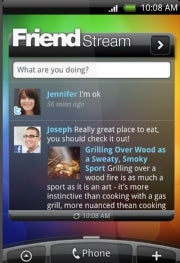
HTC Friend StreamOut of all of the custom skins for Android, HTC Sense is definitely my favorite. It is the easiest on the eyes, and it doesn't bog down the operating system by trying to do too much. The latest iteration of Sense features Leap, which is essentially an elegant way of handling multitasking; it's actually a bit reminiscent of Palm's WebOS deck-of-cards visualization. Pinch anywhere on the homescreen, and you'll jump to seven thumbnail versions of your open pages. From there, you can go to any of those open applications or close out of one.

Friend Stream, HTC's social network aggregator, allows you to view your friends' status updates, shared links, and pictures all in one seamless view. Supported social networks include Facebook, Flickr, Twitter, and others. I find such social network feeds a bit annoying--do I really need to see everybody's tweets and Facebook status updates all mixed up together? But I suppose if you're an avid social networker, seeing all of these updates in one place is useful.
One feature I found especially cool: You can tap and drag to highlight a block of text and either look up a word in a dictionary or translate it via Google Translate.

Along with the standard Android applications, such as Gmail, Google Talk, and YouTube, the phone offers HTC's Twitter app (Peep) and its photo-geotagging app (Footprints). In addition, you get a handful of Sprint apps, like SprintTV, Sprint Navigation, Sprint Zone, and Sprint Football Live.

Multimedia Machine

I'm not really a fan of HTC's Sense music player. Why? The album art doesn't take advantage of the EVO 4G's large display while the app is in Now Playing mode; it remains thumbnail-size. The Sense player is slightly prettier than the dull-as-dirt Android player, but I prefer iTunes or Palm's WebOS player. Audio sounded good, though, and the player supports a respectable range of audio and video formats. On YouTube, you get a feature called HQ, which enables you to watch better-quality videos (if available). You simply press the HQ button in the corner of the video, and a crisper, larger video--one that actually uses the EVO 4G's entire screen real estate--will load. Better yet, no 4G connectivity is needed.
Video playback via SprintTV was a disappointment, however. The video stuttered quite a bit, and the sound didn't match up. According to other reviews I've seen, it wasn't much better over a 4G connection, either.


Superb 8-Megapixel Camera

While 5 megapixels seems to be the standard for high-end smartphone cameras, the EVO 4G goes a step further with an 8-megapixel camera with a dual-LED flash. As with the iPhone 3GS, you can touch to focus on a subject. The camera's user interface is pretty straightforward, too, and it offers a handful of advanced controls such as exposure, color, white balance, and various photo effects.


Photo quality was impressive, both indoors and out. Colors appeared vivid but natural, and details looked sharp. My only complaint was that the flash tended to blow out details and color in indoor shots (see below).


You can also capture HD video with the EVO's 4G camera. I was really pleased with how well my videos turned out, though the results don't hold a candle to those of a 1080p camcorder (see test video below). You can output your photos and videos in HD quality (720p) via the HDMI port. Of course, you'll have to purchase an HDMI cable--which is unfortunately sold separately.

To share videos, look no further than Qik, an application that will come preloaded on the EVO 4G. One of my favorite mobile apps, Qik allows you to stream live videos from your phone to your family and friends, as well as to share them via social networking sites like Facebook. And, yes, Qik supports HD-quality videos.

Last but not least, the EVO 4G sports a front-facing 1.3-megapixel camera with video recording. This feature, paired with 4G speeds, opens up many exciting opportunities for app developers. I'm anticipating lots of apps with integrated video-chat clients. Imagine being able to play a multiplayer game while video-chatting with your opponents. Or, what if you could watch a video while simultaneously discussing it with a friend? The application possibilities are endless.

4G and Mobile Hotspot

Unfortunately, at this time we were unable to test the phone's 4G speeds and features, as 4G coverage has not yet rolled out in San Francisco. For more information on the advantages of 4G, see "4G Wireless: 20 Questions Asked & Answered." We'll follow up with more testing as soon as possible.

Sprint says its 4G network delivers peak download speeds that are up to 10 times faster than 3G average download speeds. Though Sprint has been talking about its WiMax service (provided via the Clearwire network) for a few years now, we haven't seen many WiMax-enabled devices outside of laptop cards and modems.

If you are in a 4G-connected area, you can use voice and data simultaneously. I'm sure you've seen those Luke Wilson AT&T commercials, so you know this is a necessary feature. Yes, you can look up a restaurant while you're on the phone making dinner plans with your friends (even though that's kind of rude). Really, though, the most useful purpose for this function is when you're connected to the mobile 4G hotspot: You won't be disconnected if you get a phone call.

With the built-in mobile hotspot, you can connect up to eight Wi-Fi-enabled devices, including a laptop, camera, music player, video player, and any other Wi-Fi-enabled device, to the 4G network. Connecting to the hotspot is simple: You can access it either by a dedicated icon on the Launcher or in your Settings menu. You then type in your SSID name, the encryption type, and your password, and you're good to go. The hotspot will cost you $30 per month on top of the $80 for the data plan and Premium Data add-on. Fortunately, there's no cap on data usage.

Solid Performance

We were able to test 3G performance, and overall I was impressed with how quickly multimedia-rich pages loaded over Sprint's network. Additionally, I was pleased with how clear my phone calls were in San Francisco. A few of my colleagues on the other end of the line noted that my voice sounded a bit tinny, but my voice was still sufficiently loud and clear--even while I stood on a busy street corner.

Like the Nexus One, the HD2, and the Droid Incredible, the EVO 4G runs on Qualcomm's 1GHz Snapdragon processor. The EVO 4G was pretty speedy in my hands-on tests, even when I had multiple applications open. Applications launched quickly, too, though a few crashed on me (Sprint Football Live and Qik were the offenders).

Though Sprint hasn't released numbers for talk-time or stand-by time, I found that I was able to go a full day with moderate data usage without needing to recharge. 4G connectivity will definitely affect battery life, however, and we'll update our review once we're able to test it.

The HTC EVO 4G represents a huge step forward for both the Android platform and Sprint's 4G network. Unfortunately, it might be a little too ahead of its time, as 4G is fairly limited here in the United States. Aside from that issue, the EVO 4G is a winner with its solid hardware, multimedia capabilities, and speediness. Even if you don't have 4G connectivity in your city, you'll be pleased with this smartphone. But don't say I didn't warn you about that additional $10-per-month fee.


SOURCE:pcworld.com
Read More!

Samsung Galaxy S: How Does It Measure Up to the Competition?

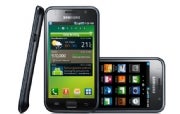
This spring, Samsung introduced the Samsung Galaxy S, a super Android smartphone to rival the HTC EVO 4G, the various Droids (both Motorola's and HTC's) and of course, the iPhone 4. Versions of the Galaxy S will be making its way to U.S. shores this summer in four different form factors to all four major U.S. carriers. I was lucky enough to get my hands on the original European Galaxy S and did some quick side-by-side comparisons with the other hot phones of the summer.

Design and Display
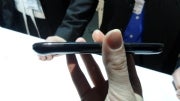
When I first picked up the Galaxy S, I was amazed with how thin and lightweight it was. I was also surprised by how familiar it looked. The design is actually very iPhone 3GS-like with an all black, shiny plastic body and minimal buttons on the phone's face. It is thinner than both the EVO 4G and the Droid X measuring 0.39-inches thick, but slightly beefier than the ultra-slim 0.37-inch iPhone 4. It is the lightest of the bunch, weighing a scant 4.2 ounces.

The Galaxy S's feather-light weight is due in part to the Super AMOLED technology, which the Samsung first introduced at Mobile World Congress on the Samsung Wave. Super AMOLED technology has touch sensors on the display itself as opposed to creating a separate layer (Samsung's old AMOLED displays had this extra layer) making it the thinnest display technology on the market. Super AMOLED is fantastic; you really have to see it in real life to experience it. Colors burst out of the display and animations appeared lively and smooth.

The Galaxy S' 4-inch display is larger than the iPhone's (3.5-inches), but smaller than the HTC EVO 4G and Motorola Droid X's displays (4.3-inches). Despite its smaller size, the Galaxy S outshined both the Droid X and the EVO 4G in my casual side-by-side comparisons. The side-by-side with the iPhone 4 was a closer call. The iPhone 4's display appeared slightly sharper, but I thought the Galaxy S's colors looked more natural. It is really hard to declare a winner--both displays are stunning.

Samsung TouchWiz 3.0 with Android 2.1
The Samsung Galaxy S runs Android 2.1 (Eclair) with Samsung's own TouchWiz 3.0 user interface. Overall, this version of TouchWiz is a lot better than the version on the Samsung Behold II for T-Mobile, which was slow and difficult to navigate. But while this version is an improvement, I encountered some familiar issues with TouchWiz 3.0. Despite the 1GHz Hummingbird processor, the phone lags when launching apps, flipping through menus and scrolling down contact lists or Web pages. This could be due to the fact that this is a pre-production unit, however, and not everything is in perfect working order.

Like HTC Sense, Samsung has its own social media aggregator. Social Hub combines streams from your Facebook, MySpace and Twitter accounts into a single view. It is a useful feature if you need a simple way to keep track of your networks. One odd feature is Mini Diary, which lets you create blog entries with photos, weather info, texts and more. This would be a great feature if you could actually sync this information to your blog or Facebook profile--but weirdly, you can't.

Camera
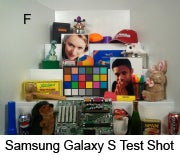
We put the Galaxy S's 5-megapixel camera through a modified version of our PCWorld Lab Test for point-and-shoot digital cameras along with the iPhone 4, the Motorola Droid X and the HTC EVO 4G. Unfortunately our test panel was not very impressed with the Galaxy's photo quality. The Galaxy S phone earned the lowest score out of the four and an overall word score of "Fair." It finished ahead of the Evo 4G in terms of exposure quality, but finished in last place in our color accuracy, sharpness, and distortion tests.

On the other hand, it took second place in overall video quality. Its performance was skewed heavily toward good performance in bright light. According to our panel, bright-light footage looked a bit underexposed and slightly grainy in a full-screen view, but great at smaller sizes. The Galaxy S's auto-focus searches a bit before locking onto a crisp image. Its microphone actually picks up audio a bit too well: our audio clip sounded far too loud and blown-out, while it was barely picked up at all by some of the other smartphones in this comparison. In low light, the footage was a bit too murky and undefined to earn a better rating.


SOURCE:PCWORLD.COM
Read More!

iPhone Tries VoIP

Truphone is showing how to use the iPhone's built-in Wi-fi for Internet telephony.
Brad Reed, Network World

The British are bringing VOIP to your iPhone.

In a demonstration at this year's DEMOfall07, British VOIP provider Truphone showed conventioneers how to use the iPhone's built-in Wi-Fi capability to make calls over Truphone's VOIP network. Truphone representatives demonstrated how a call can be initiated from a handset and then routed to Truphone's server via Wi-Fi.

Truphone spokesman Tim Donnelly Smith emphasized that the event at DEMOfall07 was only a demonstration and was not intended to be a commercial launch. He also said that the program is a native application that is installed through third-party application installers, and does not require cracking the iPhone's SIM card. This is significant in the wake of Apple's declaration earlier this week that "many of the unauthorized iPhone unlocking programs available on the Internet" could render the device "permanently inoperable when a future Apple-supplied iPhone software update is installed." Several iPhone users have reported that installing Apple's iPhone 1.1.1 update rendered their unlocked iPhones useless.

"This program doesn't do anything that Steve Jobs says not to do," said Smith. "Apple is fairly neutral on third-party applications and they won't deliberately try to break them."

In addition to its demonstration of iPhone over VOIP, Truphone demonstrated an application that allows people to call each other through the social networking site Facebook. Essentially, the application would let Facebook users embed a "call me" button into their Facebook profiles that would let friends call them without revealing their actual number over the Internet.

Smith said that the application would allow Facebook users to contact friends who use both VOIP and PSTN networks. He also said that this application is still in development and is not nearly as far along as the iPhone VOIP application.

Truphone bills itself as a "mobile operator for the Internet era" that offers "free mobile calls to other Truphone users or very cheap calls to anyone else." Its services work anyplace where there's WiFi or 3G, and it is available for use on various Nokia phones.


SOURCE:pcworld.com
Read More!

Stylish Nokia E51 Business Smartphone launched

Nokia has expanded its Eseries line of business devices with the introduction of the new Nokia E51 mobile phone. This all-round device would be perfect for businesses professionals, who require reliable and real-time access to business and people, and need to manage time effectively.


This because the Nokia E51 phone combines mobile telephony, mobile email and messaging, office phone functionality, cost savings, one phone number, one voice mailbox and one dial plan into a single device.

Here are the prominent business-related features of the Nokia E51 mobile phone:

*A home screen including user-selected icons to the most used applications
*One Touch keys with one-click access to key functionalities including email, contacts, calendar and the home screen
*Set-up wizards offering step-by-step guidance for setting up email accounts, configuring Internet calling and accessing wireless local area networks
*Integration witha wide range of business email solutions, including Nokia *Intellisync Wireless Email and Mail for Exchange to communicate with Microsoft *Exchange Server, and consumer email
*Streamlined email reading experience with easy access to attachments
*Dedicated Email key on the front cover, indicator light for new email, and a preview window to the latest email on the home screen to help keep up with email when on the move

But, if you’re a business professional and are also a fun-loving person, then the Nokia E51 will transform itself in an interestingly device as well.

The Nokia E51 phone features a 2 megapixel camera, an FM radio, music and multimedia player.

The Nokia browser serves as a gateway to a variety of Internet services such as interoperability with Windows Live. The Download! Application provides access to Yahoo Go! WidSets, and a number of travel, personal productivity and entertainment applications.

The Nokia E51 business phone will be available in Q4 2007 for a price of 350 EUR (around Rs.19,564).


SOURCE:techshout.com

Read More!

Microsoft Adds to 'Zune Phone' Speculation

Microsoft Corp. said on Tuesday that it is "not unreasonable" for the company to introduce a mobile phone combined with features of its Zune digital music player to compete with Apple Inc.'s iPhone.


The Zune phone, a topic of speculation for months since Microsoft introduced its first digital music player last year, could be driven by consumer demand for one multimedia device to make phone calls, play music and take pictures.

To date, the focus of Microsoft's mobile phone business has been providing its Windows Mobile software to handset manufacturers, but the company said an integrated business model of making both device and software could make sense.

"It wouldn't be unreasonable to think expect at some point there might some integrated thing," Mindy Mount, chief financial officer of Microsoft's entertainment and devices division, told investors at Citigroup's global technology conference.

Microsoft has sent mixed signals about the Zune phone. At the time it introduced the Zune last year, the company said a Zune phone was definitely part of its future plans.

Earlier this year, Chief Executive Steve Ballmer said at a CEO forum that the Zune phone is not a concept that Microsoft will ever do but then said it could easily add music or gaming functionality to its Windows Mobile platform.

Windows Mobile is one of Microsoft's fastest growing businesses with license sales expected to nearly double this fiscal year to more than 20 million copies.

It remains a product largely targeted at office workers, but Mount expects that to change as consumers push to combine work and personal needs onto one handset. She said she was not making any specific announcements about its future products.

Mount declined to comment on rumors that Microsoft may buy BlackBerry-maker Research in Motion Ltd., but said the company is happy with its future in mobile right now.

"What I would ask people is what (RIM) really gets you. A lot of their money is coming from the hardware business and they are going after a very particular segment," said Mount, whose division also oversees the Xbox game console and Zune music player business.

Shares of Microsoft rose 33 cents to $29.06 in afternoon Nasdaq trade, while RIM shares touched a new high of $85.88 on the Nasdaq before falling 3 cents on the day to $85.38.


SOURCE:pcmag.com

Read More!